But, since all flowers must eventually fade, I just finished a new project from the Alabama Stitch Book, by Natalie Chanin.
Sunday, November 16, 2008
Flowers, grown and made
But, since all flowers must eventually fade, I just finished a new project from the Alabama Stitch Book, by Natalie Chanin.
Wednesday, November 12, 2008
Guinness Part 2
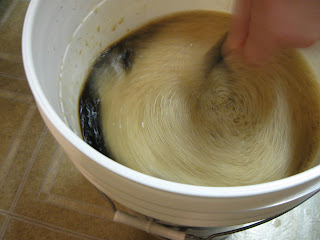
You can sort of see the hops there - they look like big oatmeal grains. After this is done, it's time to pitch the yeast, i.e. throw the yeast in. During this whole process, we've been letting the yeast packet start, so that the yeast are all fired up and ready to go. You can see how big the originally flat packet has gotten.
After it's all shook up, as it were, it's time to add more water - until you hit the 5 gallon mark on the ole bucket. Some people say you spring water, but others say tap is just fine - that all the "stuff" in tap water lets the flavors cling to something. Adding in the water is another great chance to incorporate more air into the mix. After that, you slap on the air tight lid, put your airlock in the hole, and just let 'er go. Fermentation has begun, so it has to be kept between 68-72 degrees, and out of bright light, so our bucket is living in the coat closet this time. Here's a shot of the airlock bubbling away the next day.
The main fermentation doesn't have to take that long - ours seemed tapped out after just 2-3 days. At this point, we "rack it," or syphon it out of the first fermentation bucket into the glass carboy, to let it keep fermenting away from the sediment.
And here's how she is right now, looking very dark and delicious. It'll spend another two weeks in this second fermentation, then we'll be ready to prime and bottle. Priming is adding one last additional shot of sugar to allow for the carbonation. Factory beer is pasteurized, to kill all the yeast (cause it'll make ya sick), so the beer we buy is force carbonated in order to be bubbly. This batch we're going to try priming with some of the powdered malt, instead of corn sugar. Hopefully we'll get a better, less sweet taste than in the past. I'll make sure to post about the bottling process in a few weeks. A five gallon batch usually yields about 50 bottles, or 2 cases. It's fun, but veeerrry messy.
Tuesday, November 11, 2008
My Goodness, My Guinness!
Okay, I think there's going to have to be a part 2 to this process! Next post: pitching the yeast, aerating and letting her go!
Saturday, November 8, 2008
Five Most Influential Books...
1.The Little House series by Laura Ingalls Wilder ( I can't choose just one)
2. The Anne of Green Gables books by Lucy Maud Montgomery (again, can't pick just one)
3. Misty of Chicoteague by Margeurite Henry
4. The Snowy Day by Ezra Jack Keats
5. If You Listen by Charlotte Zolotow (with the old artwork)
These are almost just a snapshot of what I'm feeling this particular day. Who can say what I might list next week, or next year? I suppose I'd call these influential in that they either stuck with me and made a deep impression upon me my whole life, or in that they showed me something new or showed me a way in which I did fit into the world.
Here's the set of Laura Ingalls Wilder books me and my sisters shared since, well, birth, I think. They are clearly well loved, and opening them - despite broken spines and very yellowed pages - is in every way like coming home. God, I love books, don't you?
Sunday, November 2, 2008
What a Beautiful Afternoon...
I just love this time of day, when the shadows get long in the back yard and the sky is all orange and bright. There's something very comforting about it to me. It's the end of the day light - the light of everyone coming home, the light of dinner time and everything being right in the world.
Wednesday, October 29, 2008
It's the Great Pumpkin!
Here's last year's model....
Tuesday, October 28, 2008
Tee hee hee!
(I know, the pictures are a little stark, but the litghting in the kitchen does not make food look yummy.)
Travis found the recipe while leafing through The Kitchen Bible, by Brigitte Hafner. This oh-so- lovely new book has about a million pictures, which, as we all know, makes a cook book good! Every dish has a color picture, and the table of contents is simply a table of pictures arranged in handy ways, like level of diffculty, or hot or cold deserts. And it has a beautiful cover - check it out. We, simple people that we are, chose someting from the "Deserts to Impress" section.
After much chocolate chopping, egg seperating, beating of whites, folding, baking and glazing - there is was, our sachertort. Apparently it's called that because it was invented by a Mr. Franz Sacher, in 1832. Anyway - it's a dense, seriously chocolate cake, layered and coated with apricot preserves, then glazed with dark chocolate. And even though ours came out a teensy tiny bit dry (don't ask) it's still damn good cake.